A new Probe Research survey for the Free Press finds that Manitobans express a relatively high level of trust in local, Canadian-owned news sources – and feel their communities are stronger with these outlets in place.
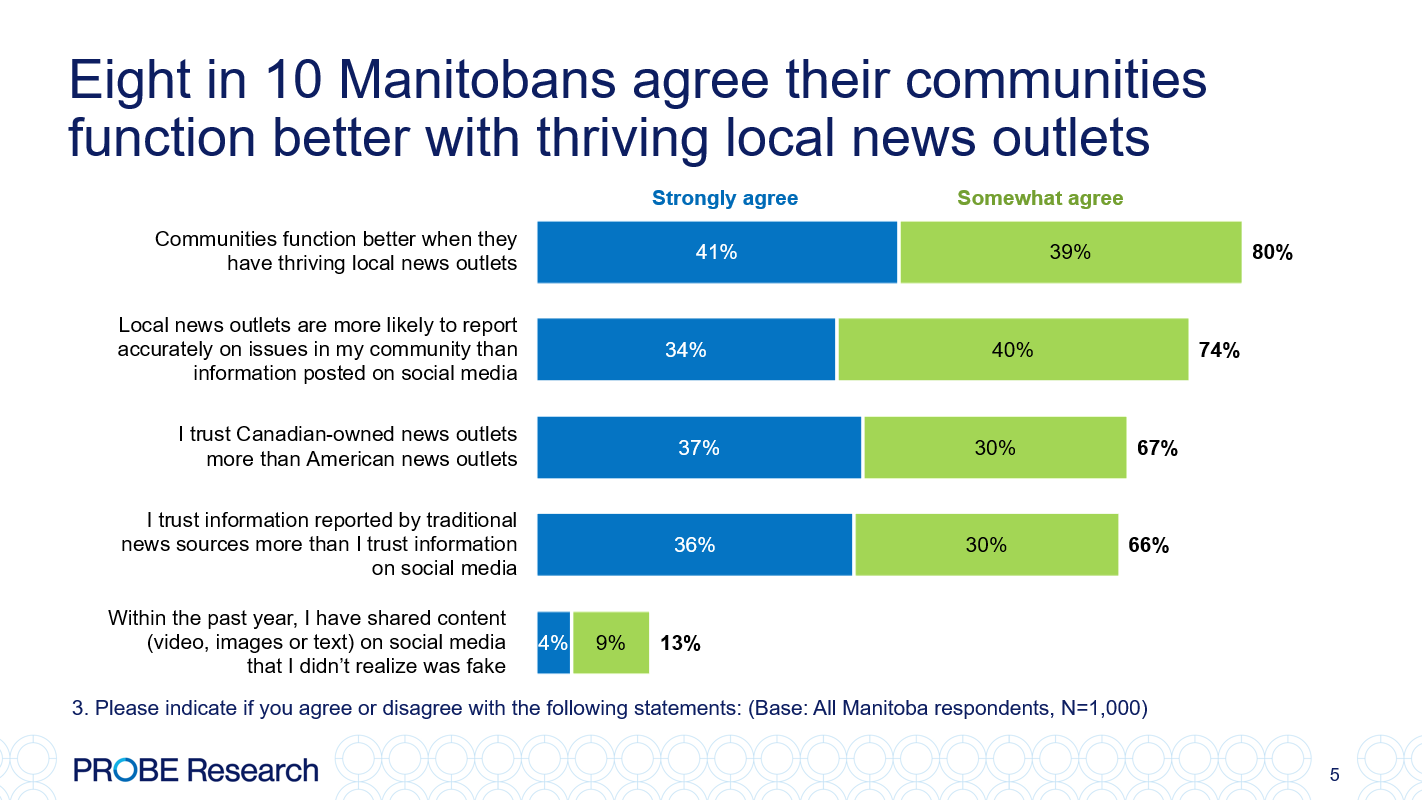
Eight in 10 Manitobans agree their communities function better with thriving local news outlets – and nearly as many agree local news outlets report more accurately on community issues than social media. Similarly, about two-thirds trust Canadian-owned outlets more than American ones (67%) and traditional news more than social media (66%).
There are stark demographic differences on this, however. By and large, older, urban and university educated Manitobans are more likely to express high levels of trust in local media, whereas those with less formal education, those living in rural and northern communities and younger adults tend to be less trusting of local news outlets.
There is also a sharp political divide, as federal Conservative and provincial Progressive Conservative (PC) supporters are more likely to disagree with the notion that local news outlets are inherently more trustworthy than social media.
Manitobans are not as confident about their ability to detect AI-generated or faked video content than their ability to spot fake news and media bias.
While two-thirds of Manitobans express some confidence that they can spot AI-generated content, only 18 per cent are very confident they can do so. Men, Manitobans under the age of 55 and those with children at home are more likely to feel confident spotting fake videos online.
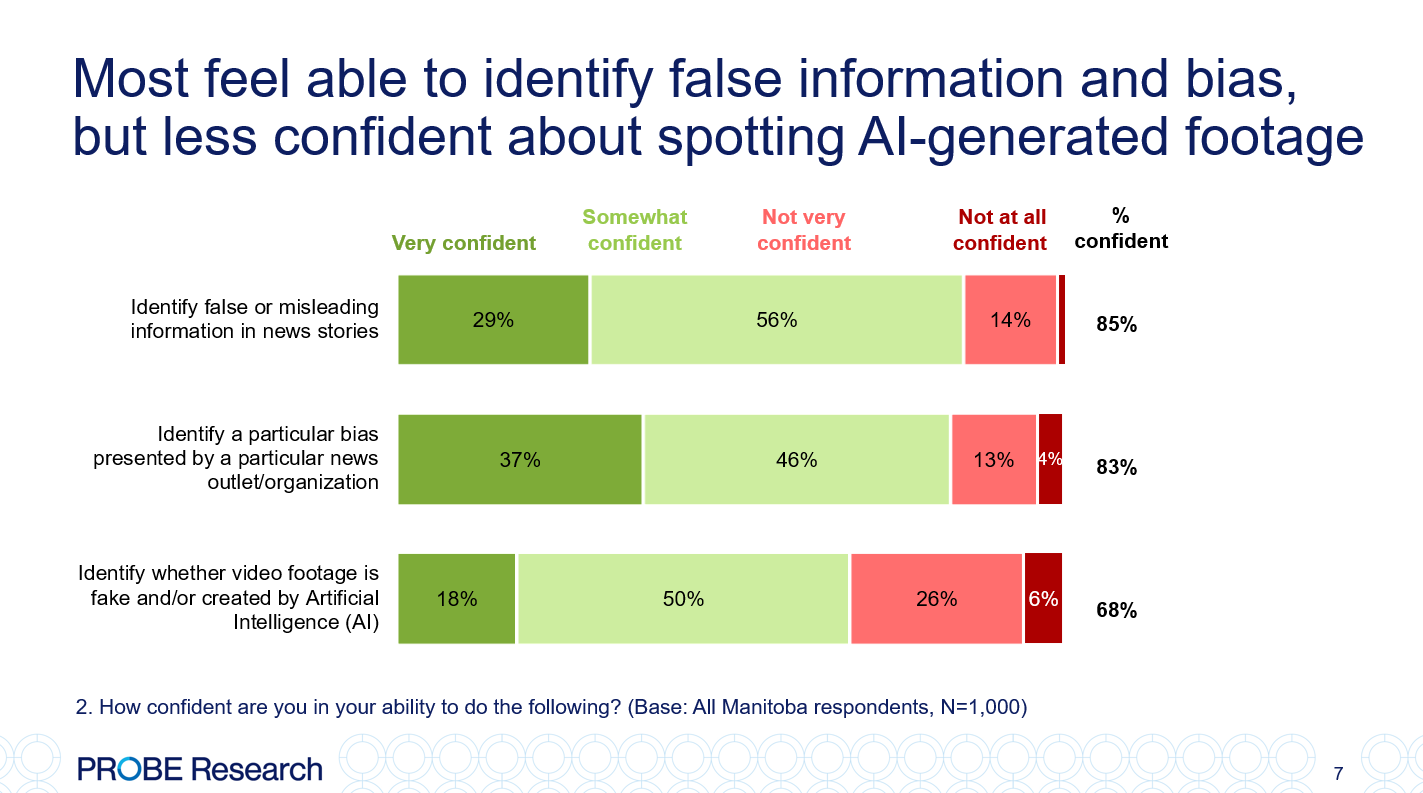
Manitobans tend to express higher degrees of confidence their ability to identify false or misleading news (85% very or somewhat confident) and perceived biases in news coverage (83%).
Meanwhile, more than one in 10 Manitobans (13%) agree that in the past year, they have shared content on social media that they later realized was fake. This was fairly consistent across all demographic groups.
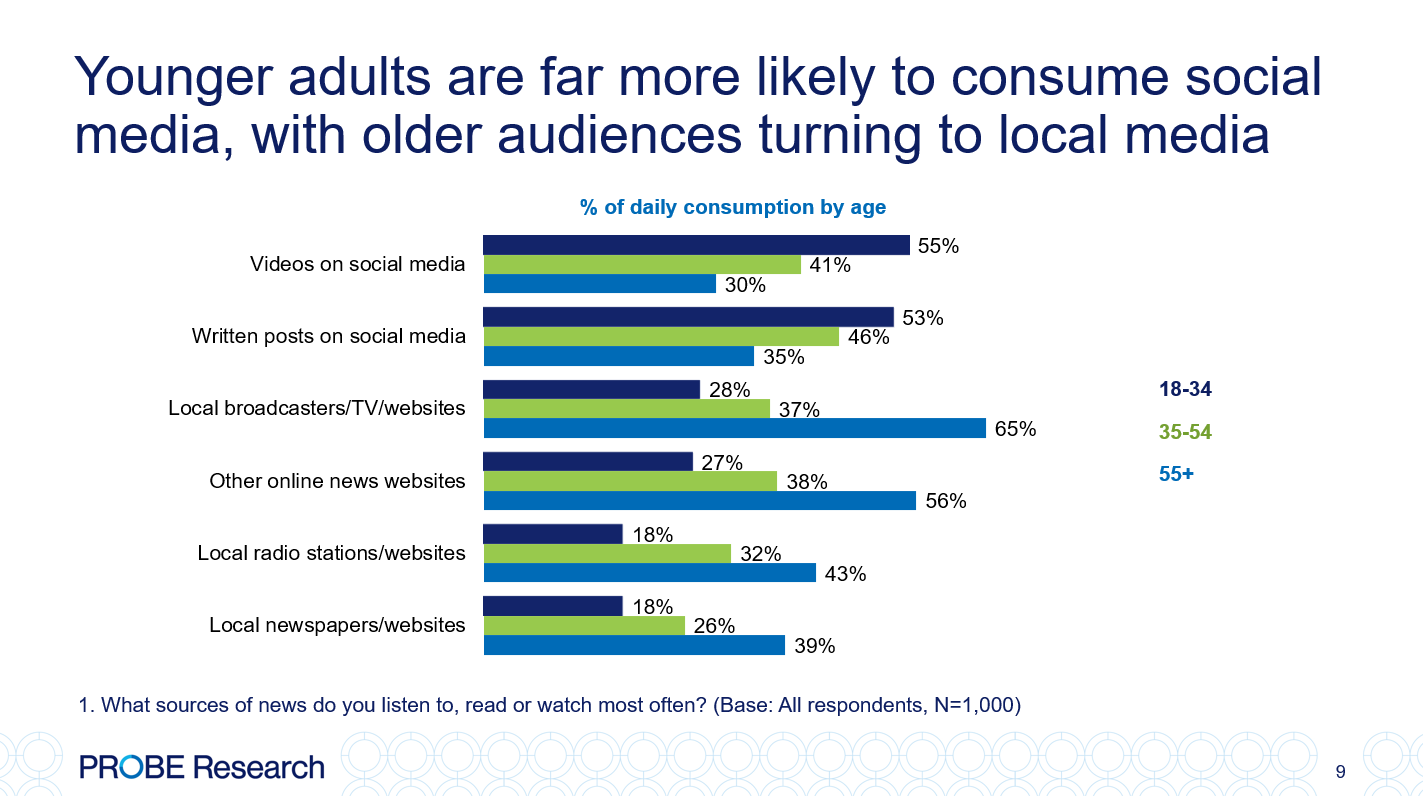
Not surprisingly, there is a major difference between how younger Manitobans and older citizens consume news and information.
Manitobans use a wide range of media channels to get news and information, with the most commonly used being local broadcasters (45% of Manitobans get news from them at least once a day, followed by social media (44% daily), other online news websites (42%) and video on social media (41%).
As expected, younger adults aged 18-34 are most likely to be heavy users of social media videos (55%) and written posts (53%) for news, whereas those over the age of 55 are far more likely to turn to local broadcasters (65%), other online news sites (56%), local radio (43%) and local newspapers (39%).
Methodology
Probe Research surveyed a random and representative sample of 1,000 Manitoba adults between November 25 and December 10, 2025.
Respondents were contacted using four different methods. The sample includes 370 Manitobans randomly recruited via live-agent operator, 166 randomly recruited via text message/SMS, 238 randomly recruited via Interactive Voice Response (IVR) and 226 members of Probe Research's online panel. All respondents completed the survey using an online platform.
With a sample of 1,000, one can say with 95 per cent certainty that the results are within ± 3.1 percentage points of what they would have been if the entire adult population of Manitoba had been surveyed. The margin of error is higher within each of the survey’s population sub-groups.
Probe reached out to Manitobans through modified random digit dialing, including both landline and wireless numbers. This ensured all Manitoba adults had an equal opportunity to participate in this survey.
The sample has been weighted slightly by age, gender, region and educational attainment so it properly reflects the province’s population, based on Census data. Probe used SPSS software to conduct all statistical analysis.
The survey was designed by Probe Research in close consultation with the Free Press.
Disclosure Statement
Probe Research is a member of the Canadian Research Insights Council (CRIC) and confirms that this research fully complies with all CRIC Standards including the CRIC Public Opinion Research Standards and Disclosure Requirements. Learn more here.