In the 12 months since Americans re-elected Donald Trump president, public opinion about the U.S. has swung dramatically in Manitoba and across Canada. As Canadians have watched a new prime minister, Mark Carney, try unsuccessfully to negotiate exceptions to Trump’s proposed tariffs on Canadian products, Manitobans appear more likely to support the status quo than a trade deal that puts Canada at a disadvantage.
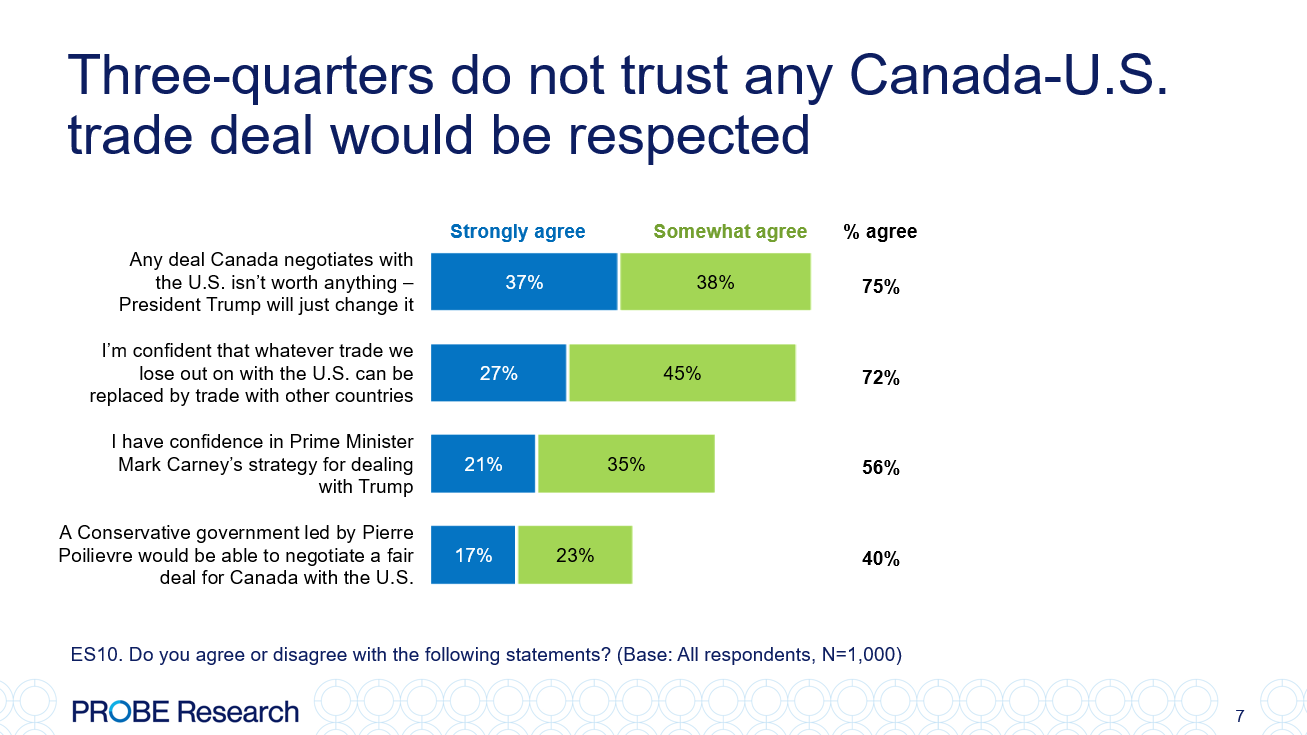
Nearly two-thirds of Manitobans agree with the statement “the U.S. is no longer Canada’s ally.” Three-quarters of Manitobans agree that any updated trade deal Canada negotiates with the U.S. is liable to be changed by Trump. With that in mind, Manitobans are twice as likely to prefer Canada make no new trade deals with the U.S. rather than being eager to sign any deal with the Trump administration. A strong proportion of Manitobans are also confident Canada can replace trade with the U.S. by selling to other countries.

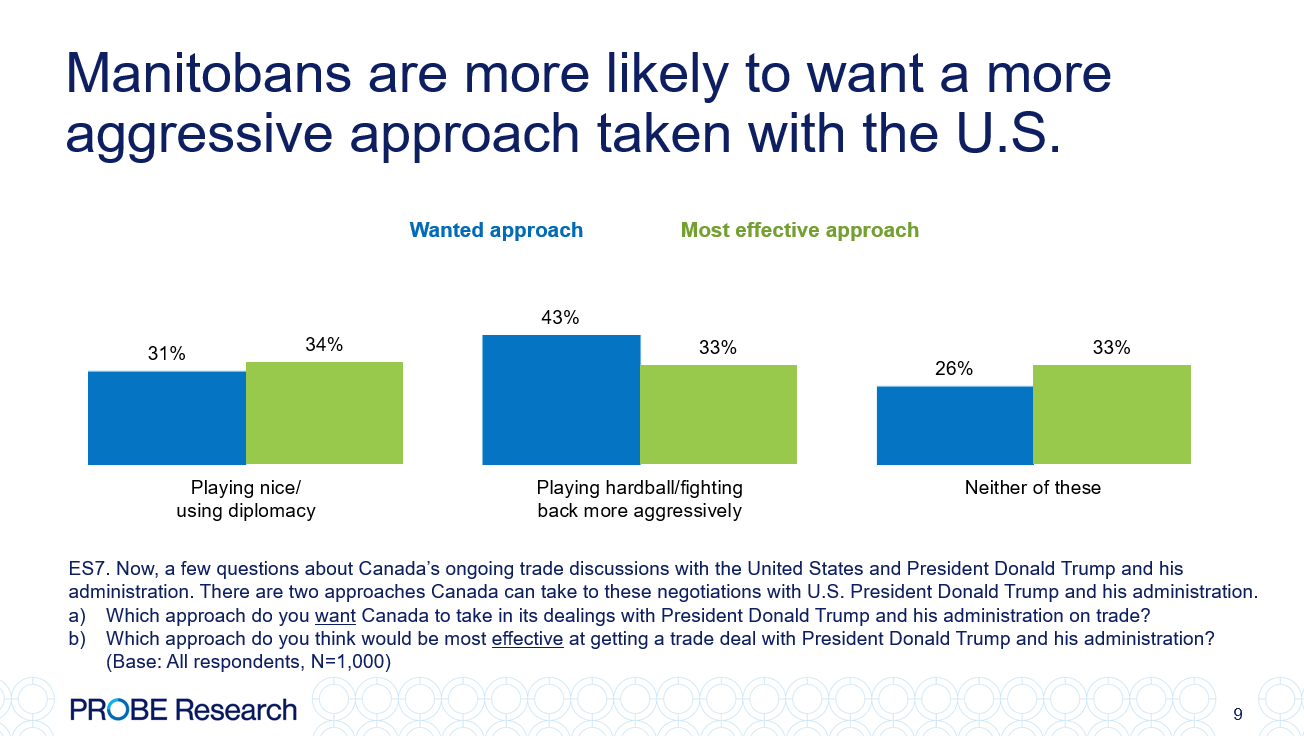
Manitobans would like Prime Minister Mark Carney and the Liberals to take a tougher approach with the Trump administration – but recognize the value of diplomacy.
When asked to choose whether they want the Canadian government to play hardball or play nice with the U.S. in trade talks, Manitobans are more inclined to want their government to be more aggressive rather than more diplomatic. However, despite wanting a tougher approach, about one in 10 Manitobans recognize that diplomacy is more likely to be effective with the Trump administration than hardball tactics. While NDP voters and younger adults are most likely to want Canada to act and talk tougher than be diplomatic, older voters are more inclined to recognize that playing nice may be more likely to yield results.
Prime Minister Mark Carney’s approach to negotiating with the U.S. has tepid support. But many Manitobans are not confident Conservative leader Pierre Poilievre could do any better.
Only four in 10 Manitobans give Carney and his Liberal government excellent or good marks for how they have handled negotiations with President Trump and the U.S. administration, with slightly more than one-half agreeing they have confidence in the approach he’s taking with Trump.
However, only four in 10 Manitobans also agree that a Conservative government led by Pierre Poilievre would negotiate a fair deal with the U.S.
Not surprisingly, these questions break down along partisan lines, with Liberal supporters more likely to express confidence in their party’s leader and Conservatives less enthusiastic about the job he’s doing – and more likely to believe their party’s leader could do better.
Conservative voters stand out for being much more sympathetic to the U.S. and more inclined to make any trade deal.
Federal and provincial Conservative voters in Manitoba remain more likely to see the country next door as an ally and are much more likely to want to see Canada find a way to negotiate a trade deal with the current U.S. administration. Whether it’s pragmatism or sympathy for Trump’s positions, these voters stand out for wanting Canada to take a more conciliatory position and negotiate a trade deal.
These voters – who tend to be younger, not have university degrees and more likely to be found in rural Manitoba – are also much less confident in how Mark Carney and the Liberals are dealing with the U.S. administration. Unlike their older, urban counterparts who support the two progressive parties, Conservative voters are also more likely to still be travelling to the U.S. – and much less likely to look down on someone who chooses to visit this country right now.

Methodology
Probe Research surveyed a random and representative sample of 1,000 Manitoba adults between November 25 and December 10, 2025.
Respondents were contacted using four different methods. The sample includes 370 Manitobans randomly recruited via live-agent operator, 166 randomly recruited via text message/SMS, 238 randomly recruited via Interactive Voice Response (IVR) and 226 members of Probe Research's online panel. All respondents completed the survey using an online platform.
With a sample of 1,000, one can say with 95 per cent certainty that the results are within ± 3.1 percentage points of what they would have been if the entire adult population of Manitoba had been surveyed. The margin of error is higher within each of the survey’s population sub-groups.
Probe reached out to Manitobans through modified random digit dialing, including both landline and wireless numbers. This ensured all Manitoba adults had an equal opportunity to participate in this survey.
The sample has been weighted slightly by age, gender, region and educational attainment so it properly reflects the province’s population, based on Census data. Probe used SPSS software to conduct all statistical analysis.
The survey was designed by Probe Research in close consultation with the Free Press.
Disclosure Statement
Probe Research is a member of the Canadian Research Insights Council (CRIC) and confirms that this research fully complies with all CRIC Standards including the CRIC Public Opinion Research Standards and Disclosure Requirements. Learn more here.