The federal NDP will choose a new leader in Winnipeg next weekend. On the cusp of the party's leadership convention, a new Probe Research survey for the Free Press finds New Democrats' fortunes in Manitoba fading. Federal NDP support has dropped significantly throughout Manitoba and remains mostly concentrated in inner-city Winnipeg, where it holds one of its only remaining seats in the House of Commons.
As support for the federal NDP falls away, the governing Liberals appear to be benefitting – although Conservative support is holding its own. Prime Minister Mark Carney and the federal Liberals currently hold a seven-point edge over Pierre Poilievre and the Conservatives (46% vs. 39%). The Liberals gained three percentage points in the last quarter versus a +1% increase for the Conservatives. NDP support has fallen to just eight per cent province-wide (-6% vs. December).
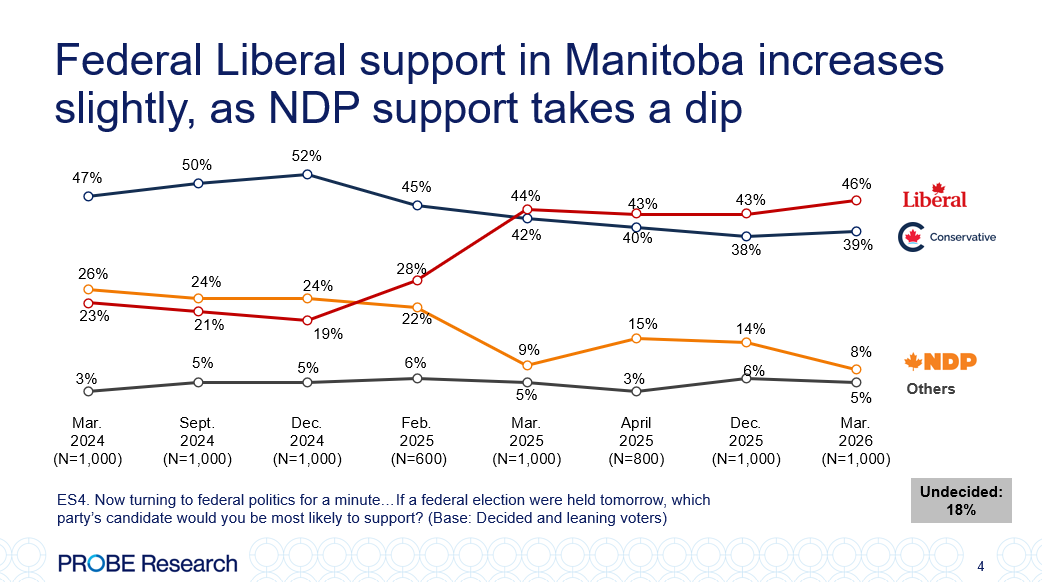
The Conservatives are maintaining a healthy lead outside Winnipeg (51% vs. 33% for the Liberals and just 5% for the NDP). Interestingly, support for other parties in rural and northern Manitoba has gone up in the past few months, with five per cent backing the Greens and four percent backing the People’s Party.
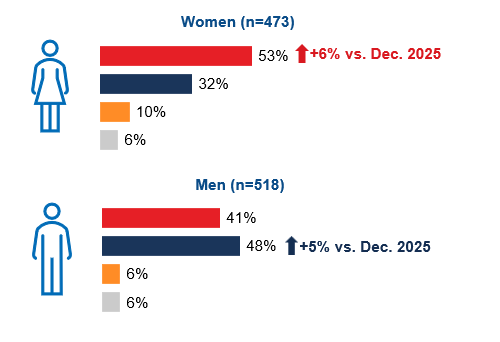
Past NDP support appears to be splitting along gender lines. As NDP support has decreased, the Liberals have picked up more support among women, with men gravitating to the Conservatives. Liberal support among women is six percentage points higher than it was in December, with the Liberals now holding a very large advantage over the Conservatives (53% vs. 32%). Among men, nearly one-half now back the Conservatives (48%, up from 43% in December), with 41 per cent of men preferring the Liberals.
Younger Manitobans remain much more likely to prefer the Conservatives, with the party now up to 44 per cent support among those aged 18-34. Liberal support remains very strong among those 55+ (54%) and has increased significantly among those aged 35-54 in the past three months (44%, up from 35% in December).
Methodology
Probe Research surveyed a random and representative sample of 1,000 Manitoba between March 1 and 17, 2026.
Respondents were contacted using four different methods. The sample includes 466 Manitobans randomly recruited via live-agent operator, 139 randomly recruited via text message/SMS, 195 randomly recruited via Interactive Voice Response (IVR) and 200 members of Probe Research's online panel. All respondents completed the survey using an online platform.
With a sample of 1,000, one can say with 95 per cent certainty that the results are within ± 3.1 percentage points of what they would have been if the entire adult population of Manitoba had been surveyed. The margin of error is higher within each of the survey’s population sub-groups.
Probe reached out to Manitobans through modified random digit dialing, including both landline and wireless numbers. This ensured all Manitoba adults had an equal opportunity to participate in this survey.
The sample has been weighted slightly by age, gender, region and educational attainment so it properly reflects the province’s population, based on Census data. Probe used SPSS software to conduct all statistical analysis.
The survey was designed by Probe Research in close consultation with the Free Press.
Disclosure Statement
Probe Research is a member of the Canadian Research Insights Council (CRIC) and confirms that this research fully complies with all CRIC Standards including the CRIC Public Opinion Research Standards and Disclosure Requirements. Learn more here.