The process of setting election boundaries is usually technical and dry in Canada. But in Alberta this year, there has been a lot of debate about what the maps for the next election will look like – and the public is skeptical of the approach the United Conservative Party (UCP) government is taking to setting these new constituency boundaries ahead of the 2027 provincial vote.
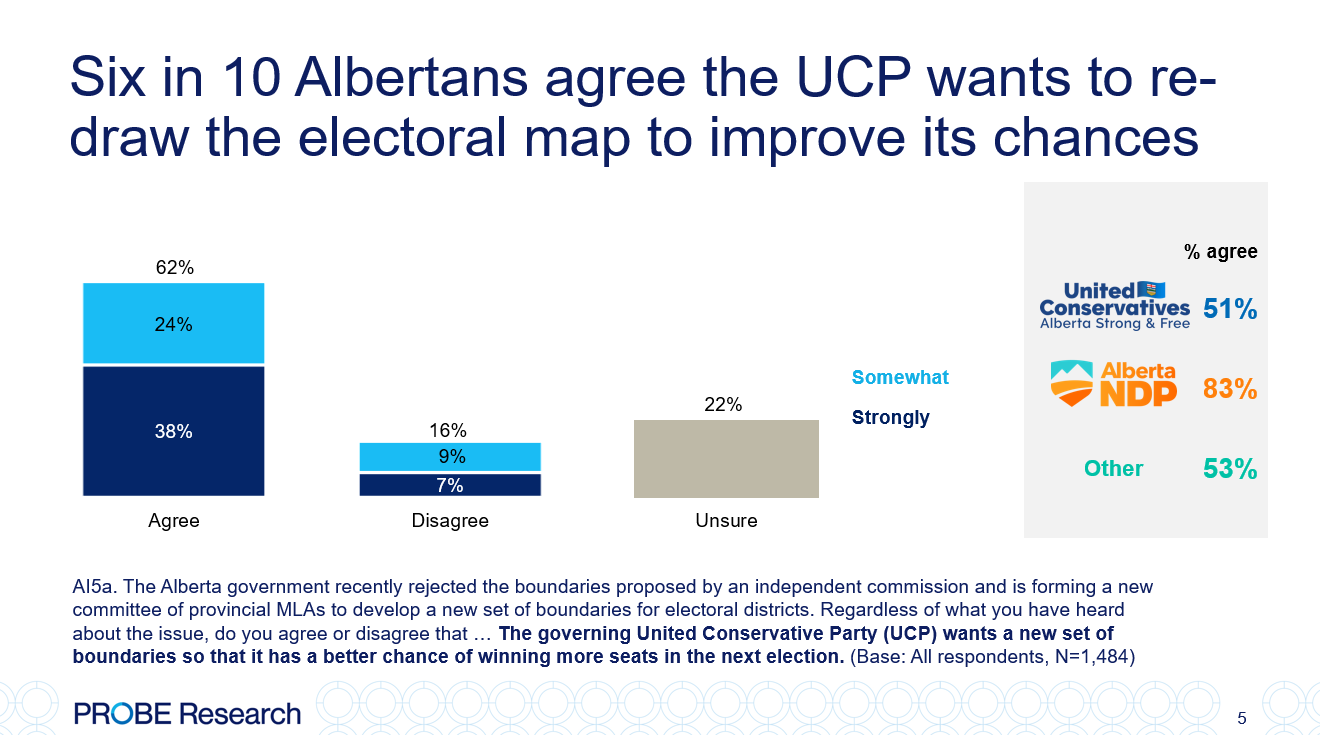
A new Probe Research survey finds more than two-thirds of Albertans agree independent commissioners, rather than elected officials, should be tasked with drawing these boundaries, which is how provincial constituency boundaries are drawn in other provinces. This includes two-thirds of UCP supporters and eight in 10 NDP supporters.
Until now, the constituency maps have been devised by an all-party committee of elected MLAs. The debate over the process started when the UCP MLAs on this committee submitted their own proposed maps that were different than those proposed by the minority. In response, the UCP government struck a new committee of elected officials to create a different set of boundaries.
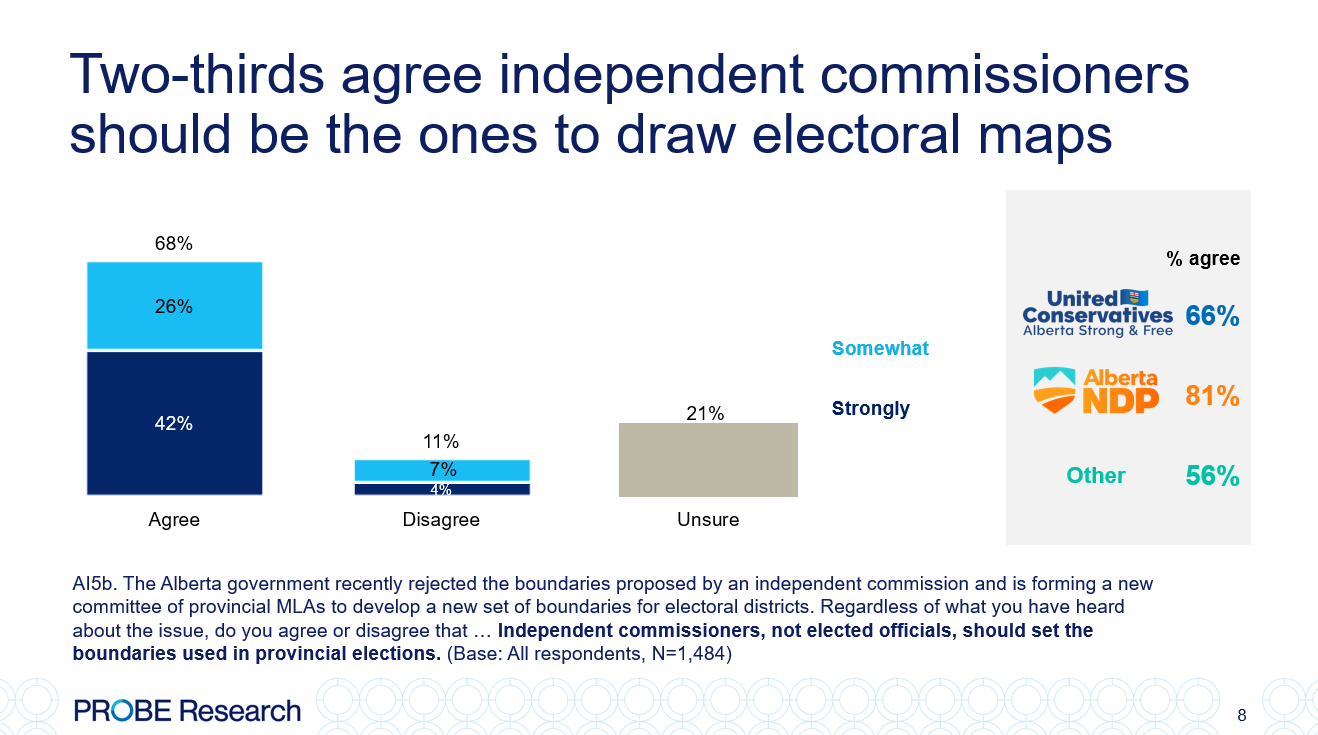
Further to this, more than six in 10 Albertans – including one-half of UCP supporters – agree the government decided to scrap the first set of proposed boundaries to give itself a better chance of winning the next election. These results suggest Albertans expect their work to produce boundaries that favour the UCP in the next election.
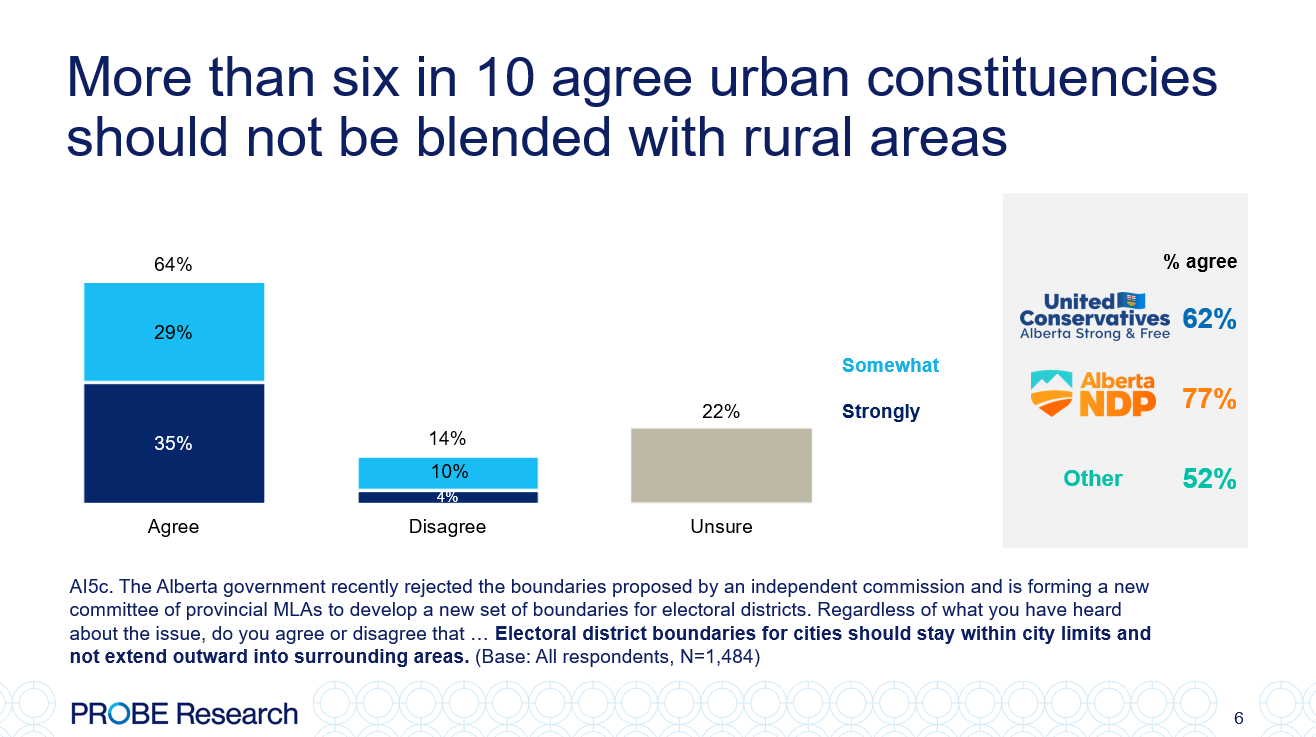
A similar proportion of Albertans also agree constituency boundaries for urban ridings should remain within city limits. The minority group of MLAs on the previous redistricting committee proposed seats that would blend urban voters in smaller cities like Lethbridge with rural voters in outlying communities. A majority of Albertans do not agree with this approach, including six in 10 UCP supporters and more than three-quarters of NDP supporters. Nearly two-thirds of those who live in these smaller cities also agree the boundaries for urban seats should remain in city limits and not be melded with rural areas.
The Story
Unlike in the U.S., the process of setting electoral boundaries is usually not that controversial in Canada. Although the approach varies in different parts of the country, choosing who votes where tends to be de-politicized and not contentious. In Alberta this year, that seems to have shifted, as the approach the UCP government has taken appears to be offside with even a strong proportion of its own supporters. These results suggest Albertans want to ensure the political players in the arena do not also get to set the rules of the game to their advantage.
Methodology
Probe Research conducted an online survey with a representative sample of 1,484 Alberta adults between April 27 and May 6, 2026. This included an oversample of 598 Calgary adults.
All respondents were recruited from a national online panel (LEO). The sample has been weighted slightly by age, gender, region and educational attainment so it properly reflects Alberta’s population, based on Census data. The totals calculated in this report are based on weighting back oversampled groups to the correct proportions within the overall population.
Because an online survey is a sample of convenience, no margin of error can be ascribed. For the purposes of comparison, a probabilistic sample of 1,484 would have a margin of error of ± 2.5 percentage points, 19 times out of 20. The margin of error would be higher within each of the survey’s population sub-groups.
The survey instrument was designed and paid for by Probe Research.
About Probe Research
Probe Research is one of Canada’s leading public opinion and market research firms, serving as an indispensable insights partner to clients and communities throughout the country.
The Probe team blends the traditions of social science and journalism to help clients better understand the world around them – asking the most insightful questions and using storytelling skills to make data come to life and drive strategic decision-making.
All research conducted by Probe Research is based on responses from real human respondents. Probe Research is a member of the Canadian Research Insights Council (CRIC) and complies with its Public Opinion Research Standards.