During the past year, Canadians have been hearing a lot about major projects – big, transformative infrastructure investments led by the federal government. Ottawa’s new Major Projects Office (MPO) is either moving ahead with or evaluating major investments related to energy, resource extraction and transportation.
Probe Research examined what Canadians know and think about six of these potential major projects:
- The Alto high speed railway corridor between Toronto and Quebec City.
- The small modular nuclear reactor (SMNR) project in southern Ontario (Darlington New Nuclear Project).
- The Port of Churchill Plus project in northern Manitoba.
- The Ksi Lisims liquefied natural gas (LNG) export facility in northern B.C.
- The Pathways Plus carbon capture and storage project in Alberta.
- Wind West Atlantic Energy, an offshore wind development in Nova Scotia.
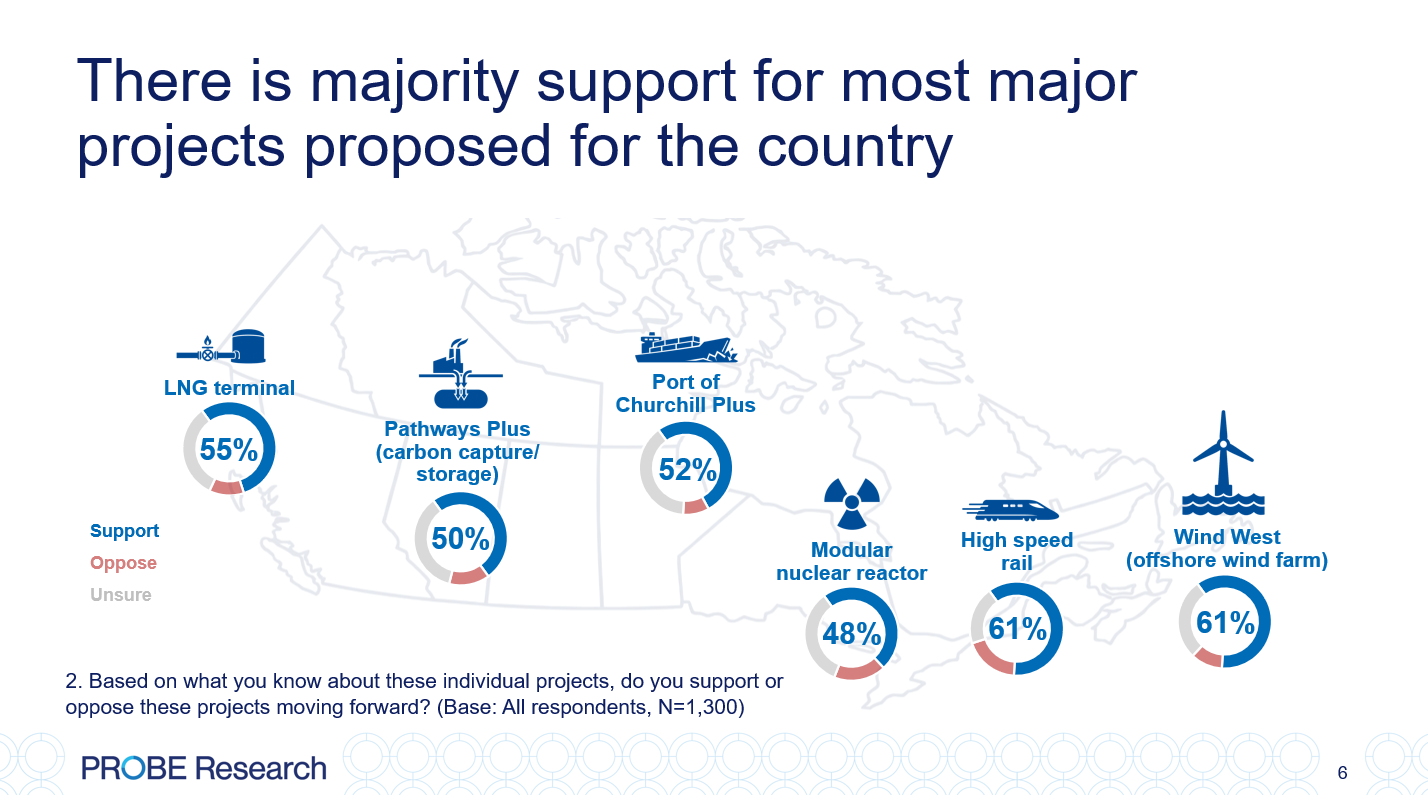
Canadians are expressing tepid support for these projects – but opinions remain volatile. Canadians are most likely to be aware of – and supportive of – the proposed high-speed rail corridor between Toronto and Quebec City. While support for this project is relatively strong, there is some degree of opposition to it in Western Canada and Ontario. Small majorities of Canadians are also in favour of building an offshore wind farm near the coast of Nova Scotia (Wind West), building a liquefied natural gas and export facility in northern B.C. and expanding the Port of Churchill in northern Manitoba. Support for the Pathways Plus carbon capture and storage project in Alberta and building small nuclear reactors in southern Ontario is slightly lower than for these other projects.
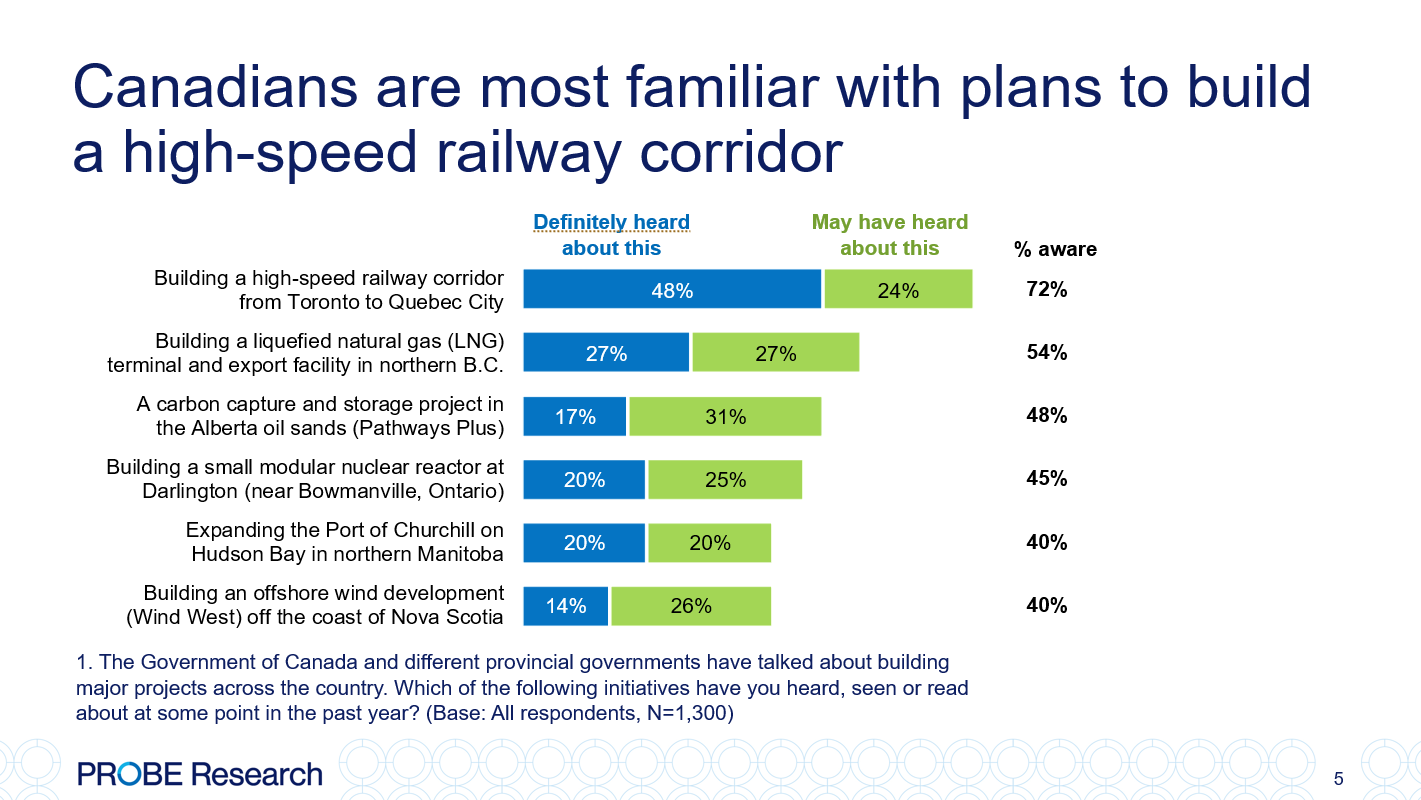
It should be noted, however, that many Canadians have not heard about these projects (except the high-speed rail corridor) and have not formed opinions one way or the other.
Perhaps not surprisingly, those in Western Canada are more likely to express support for the three energy-related projects in their region, with Albertans especially likely to back the LNG terminal in northern B.C. and the Pathways Plus project in their own province.
The Port of Churchill expansion, which may include a pipeline component, also has higher support in the three Prairie provinces – especially Manitoba, where more than three-quarters strongly or somewhat support this project.
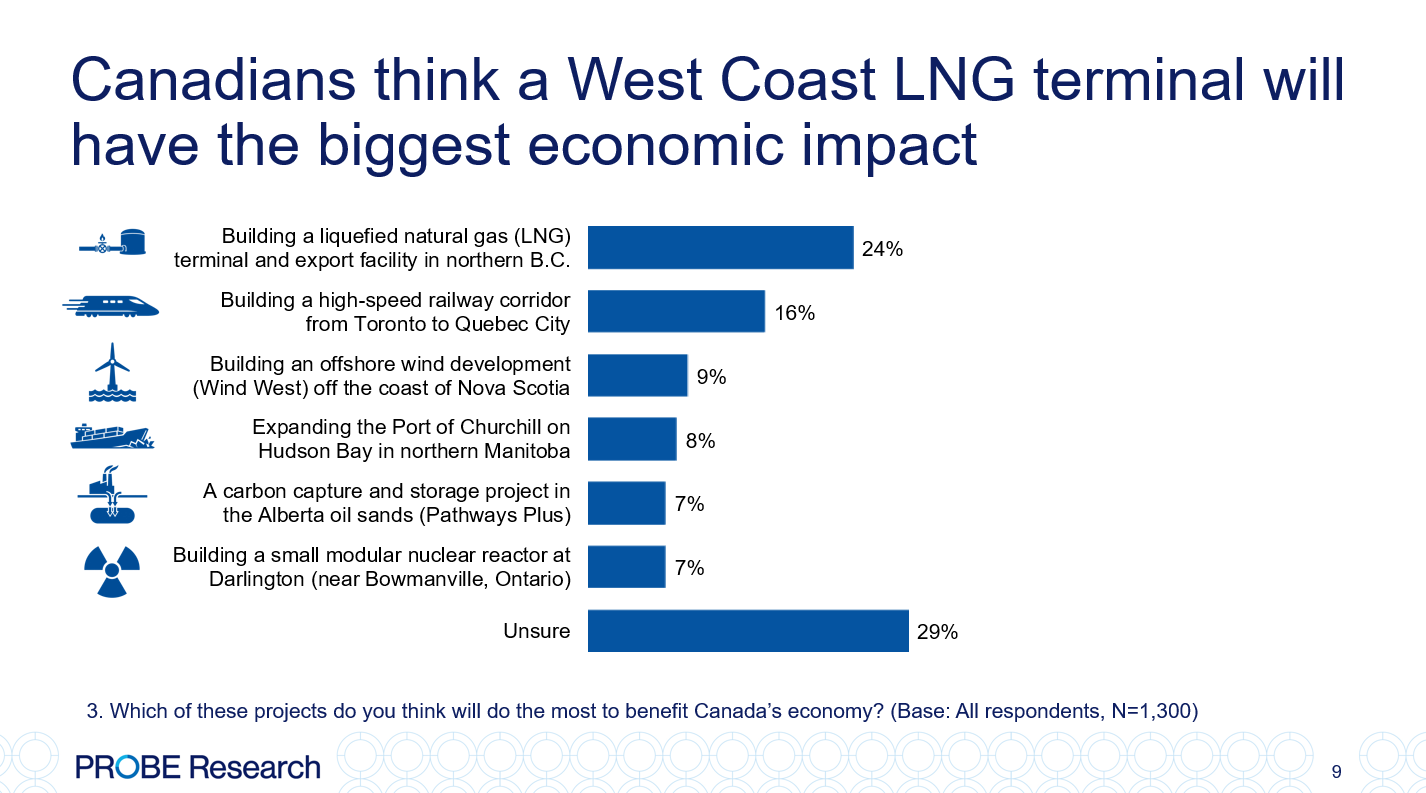
Canadians are also most likely to believe the LNG terminal in B.C. will provide the greatest benefit to the country’s economy, with the high-speed rail corridor in Central Canada as their second choice. Those living in Manitoba, meanwhile, are most likely to believe expanding the Port of Churchill will be the most economically beneficial major capital project.
While Canadians may not know much about the Port of Churchill expansion, but they are quite open to arguments in favour of this investment. Manitoba Premier Wab Kinew and other Western Canadian business leaders have championed the Port of Churchill Plus project, which involves upgrading the Hudson Bay Railway, building an all-weather road to Churchill, having more icebreakers to extend the shipping season and potentially building a pipeline to export crude oil or natural gas to international markets.
Nearly two-thirds of Canadians agree it makes economic sense for governments to financially support this project, with more than six in 10 agreeing these investments will lead directly to Canada selling more commodities to European customers. Six in 10 also agree that knowing Indigenous leaders are involved in the decision-making process – something Kinew has proposed through a new Crown-Indigenous partnership – makes them feel better about supporting this project. As might be expected, Manitobans are most likely to agree with the economic and trade arguments for expanding the Port – but are no more sold than others on the involvement of Indigenous leadership.
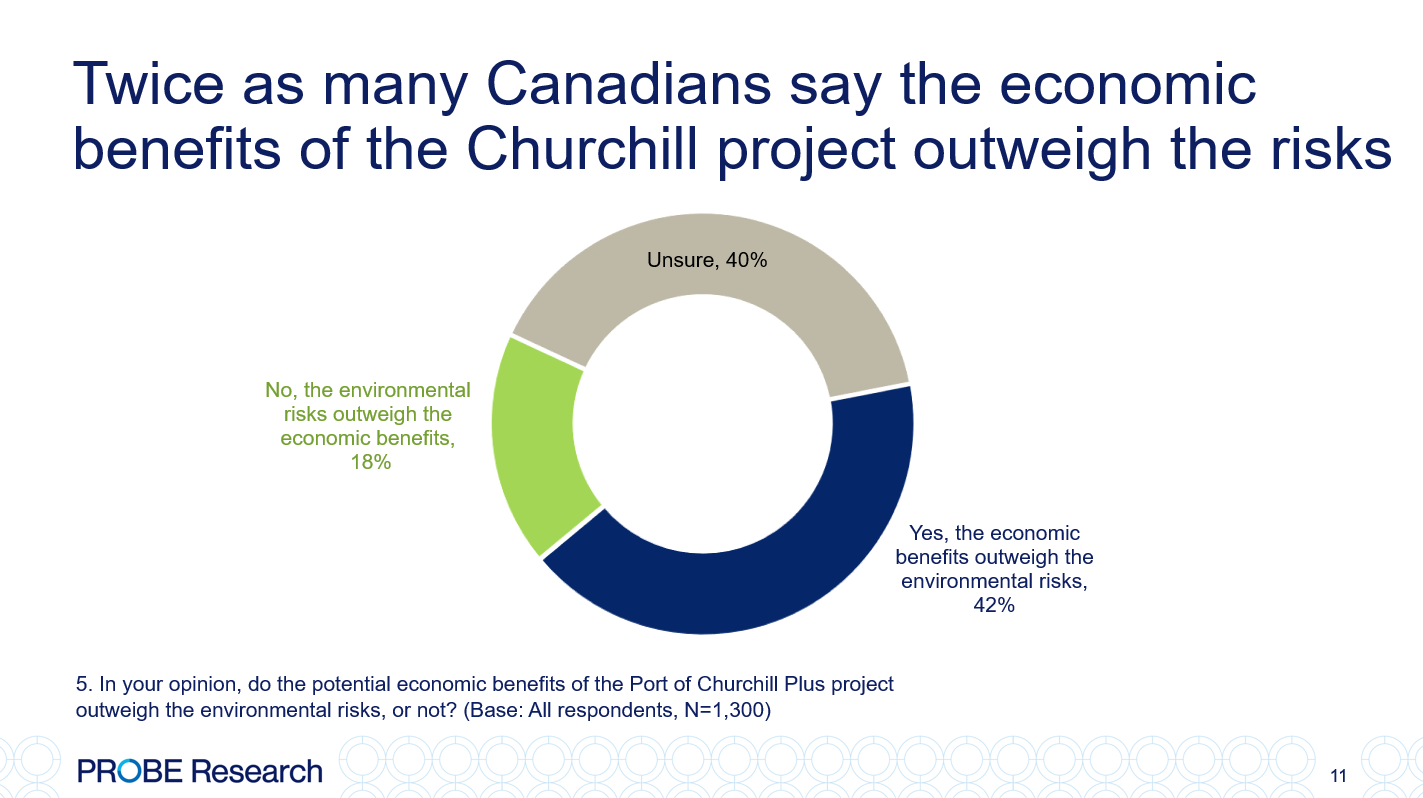
Canadians are more willing to accept the potential environmental trade-offs that would come with expanding the Port of Churchill. By a ratio of two to one, Canadians are more likely to agree the economic benefits outweigh the environmental risks associated with expanding this northern port. (Four in 10 have no opinion). More than four in 10 indicate the potential economic benefits are worth it – interestingly, this is an area where both Conservative and Liberal supporters agree. Nearly one-half of Canadians also agree that a larger port with more shipping could cause damage to sensitive beluga whales and polar bear habitats.
Methodology
Probe Research conducted an online survey of N=1,300 Canadians over the age of 18, as well as a supplemental survey of N=488 Manitoba adults. The national survey of N=1,300 adults was conducted between April 6 and 14, 2026 using a national online sample provider (LEO). The survey of N=488 Manitobans was conducted between April 10 and 15, 2026 using Probe Research’s proprietary online panel of Manitobans.
An online panel is a non-probabilistic sample of convenience, so no margin of error can be ascribed. For the purposes of comparison, a random sample of N=1,300 Canadians has a margin of error of ± 2.7 percentage points, 19 times out of 20, while a random sample of N=488 Manitobans has a margin of error of ± 4.4 percentage points
Probe applied minor statistical weighting to the sample based on age, gender, region, educational attainment and past federal voting preference so that the sample properly reflects Canada’s population.
Disclosure Statement
Probe Research is a member of the Canadian Research Insights Council (CRIC) and confirms that this research fully complies with all CRIC Standards including the CRIC Public Opinion Research Standards and Disclosure Requirements. Learn more here.
About Probe Research
Probe Research is one of Canada’s leading public opinion and market research firms, serving as an indispensable insights partner to clients and communities throughout the country.
The Probe team blends the traditions of social science and journalism to help clients better understand the world around them – asking the most insightful questions and using storytelling skills to make data come to life and drive strategic decision-making.
The survey instrument was designed and paid for by Probe Research.