
When it comes to the future security of their country, many Manitobans are contemplating scenarios they wouldn’t have imagined five years ago. Donald Trump’s return to the White House upended both Canada-U.S. relations and America’s global approach. Besides musing about annexing Greenland and making Canada the 51st state, during the past few months, the Trump administration has forcibly removed Venezuela’s president, blockaded Cuba – and now attacked Iran.
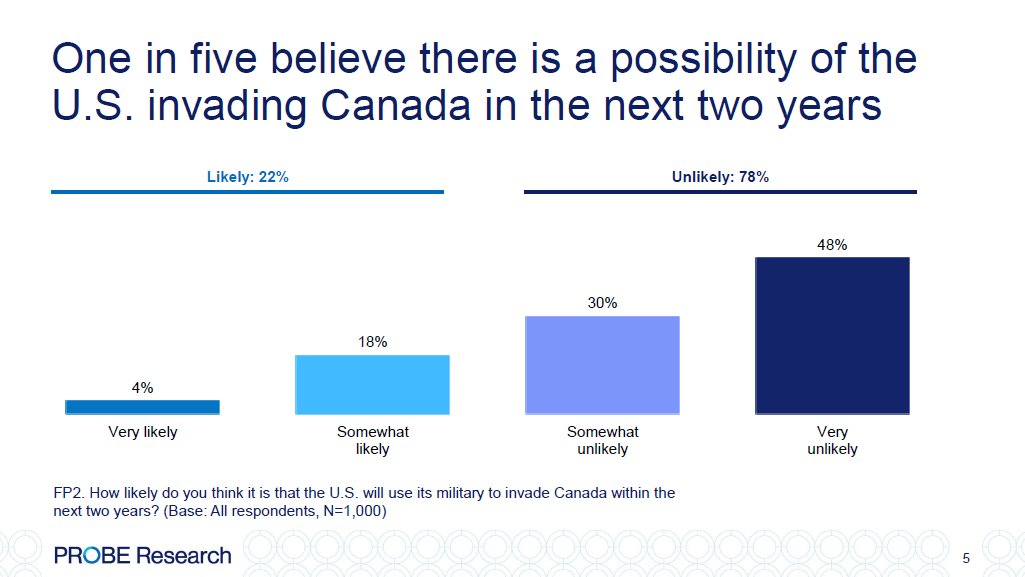
Against this backdrop, a new Probe Research poll for the Free Press finds a significant share of Manitobans believe Canada may be the next target very soon. More than one in five believe it is at least somewhat likely the U.S. will invade Canada in the next two years. Women – especially younger women – are most likely to believe this could happen. Related to this, there continues to be very little support for voluntarily joining the U.S. (13% support today vs. 11% in June 2025).
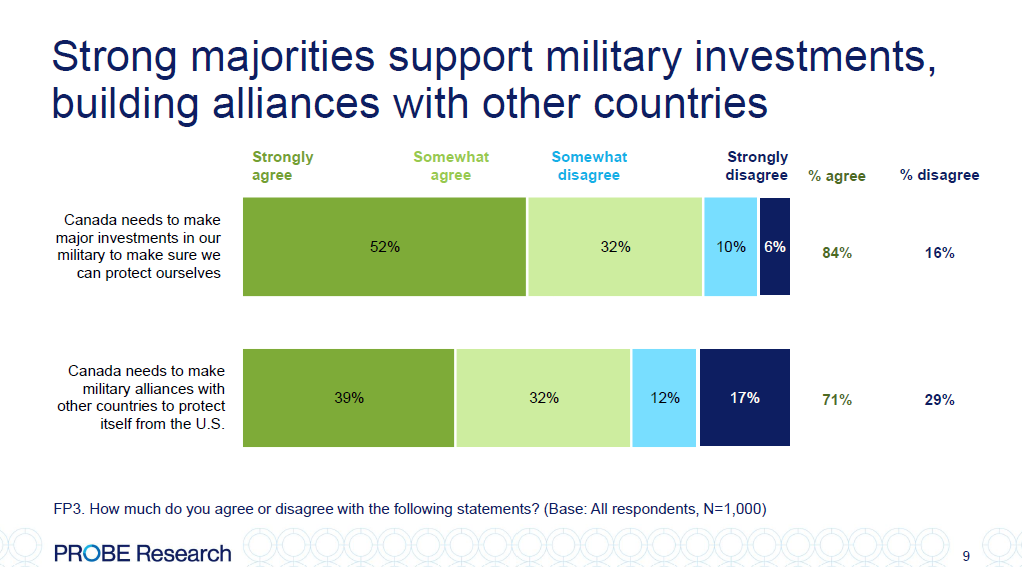
A broad consensus has emerged that investing in Canada’s military is a good idea. More than eight in 10 are in favour of putting more money into the Canadian Armed Forces to better protect the country. This sentiment is widely shared across most demographic groups and is one of the few areas where there is broad agreement among both federal Liberal and Conservative supporters.
There is less agreement, however, on the need to forge military alliances with other countries. While seven in 10 agree that Canada should ally itself with others to protect against a potential U.S. annexation, fewer than one-half of Conservative voters think this is a good idea. Support for seeking out other allies is also higher among older Manitobans.
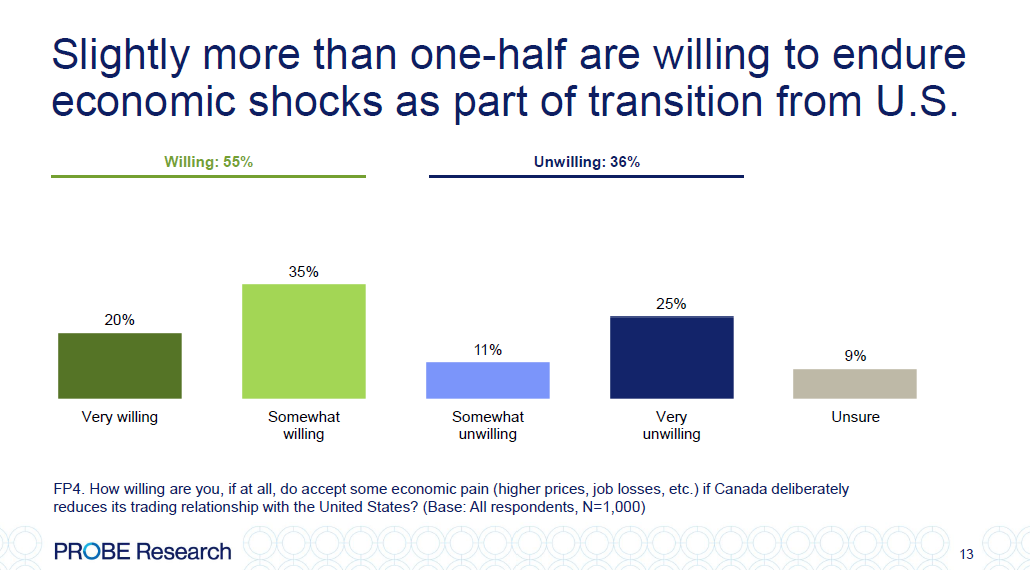
Those who might see themselves as being in relatively comfortable circumstances are more willing to endure the negative economic fallout of shifting Canada’s trading relationships. Overall, slightly more than one-half of Manitobans are very or somewhat willing to deal with economic pain in the form of higher prices or job losses if Canada reduces how much it trades with the U.S. However, this sentiment is stronger among older/retired Manitobans, as well as those who are employed in white collar professions. Although there is little difference in terms of household income, younger adults (especially men), as well as those who work in blue collar and service jobs, are much less willing to endure economic hardship if Canada’s trading relationship starts to orient away from the U.S.
These results point to a major difference in Manitobans’ mindsets when it comes to navigating the Canada-U.S. relationship. Those who see their economic circumstances as more precarious – such as younger, blue-collar men – may see the U.S. as less of an economic and military threat to Canada than older, more secure Manitobans. Although the vast majority of Manitobans do not want to become Americans, significant swaths of the public still see the U.S. as an ally and are reluctant to endure a situation where Canada might be economically weaker and less reliant on the U.S.
Methodology
Probe Research surveyed a random and representative sample of 1,000 Manitoba between March 1 and 17, 2026.
Respondents were contacted using four different methods. The sample includes 466 Manitobans randomly recruited via live-agent operator, 139 randomly recruited via text message/SMS, 195 randomly recruited via Interactive Voice Response (IVR) and 200 members of Probe Research's online panel. All respondents completed the survey using an online platform.
With a sample of 1,000, one can say with 95 per cent certainty that the results are within ± 3.1 percentage points of what they would have been if the entire adult population of Manitoba had been surveyed. The margin of error is higher within each of the survey’s population sub-groups.
Probe reached out to Manitobans through modified random digit dialing, including both landline and wireless numbers. This ensured all Manitoba adults had an equal opportunity to participate in this survey.
The sample has been weighted slightly by age, gender, region and educational attainment so it properly reflects the province’s population, based on Census data. Probe used SPSS software to conduct all statistical analysis.
The survey was designed by Probe Research in close consultation with the Free Press.
Disclosure Statement
Probe Research is a member of the Canadian Research Insights Council (CRIC) and confirms that this research fully complies with all CRIC Standards including the CRIC Public Opinion Research Standards and Disclosure Requirements. Learn more here.