Artificial Intelligence (AI) is becoming embedded in our daily lives. It shapes how we work, how we plan our days – and even how we decide where to travel, where to eat and what to listen to.
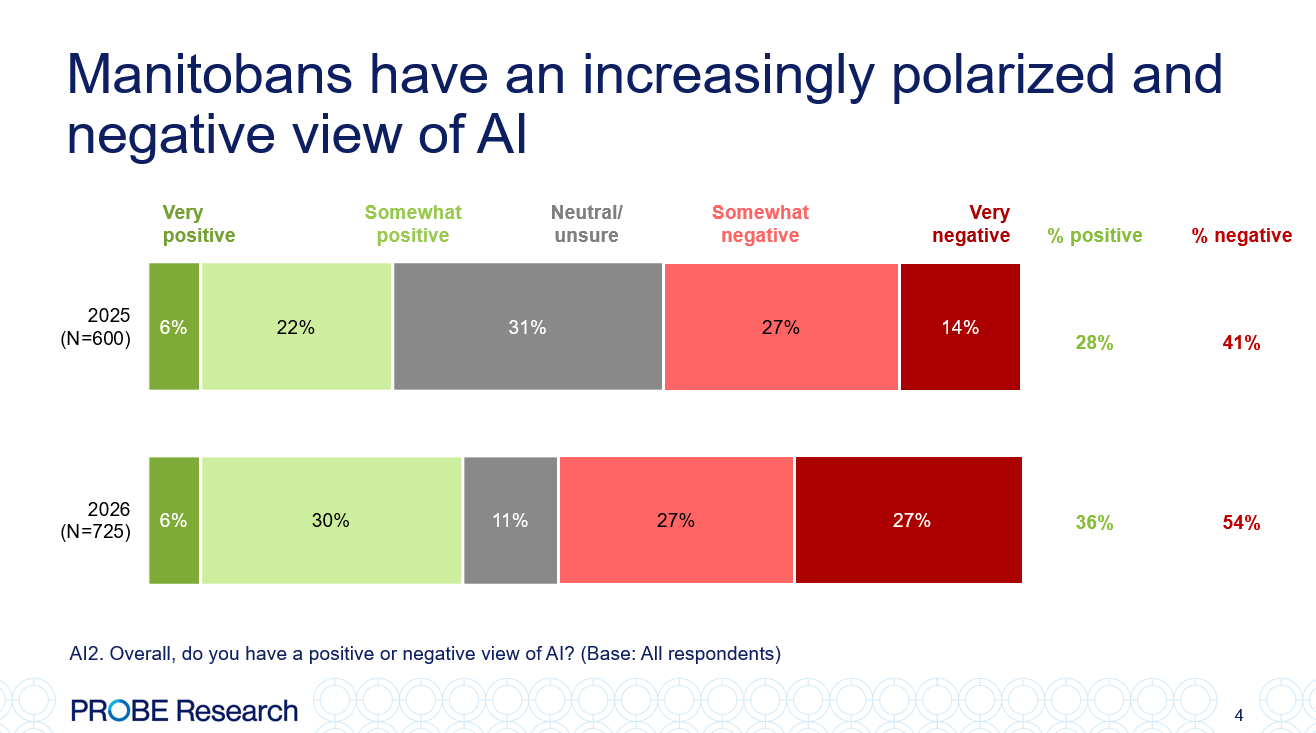
As AI becomes an integrated feature of life, new survey insights from Probe Research show that Manitobans’ views of it are polarizing – which will likely have profound implications for government decision-makers, businesses and others in the coming years.
More than one-half of Manitobans now hold a negative view of AI, compared to one-third who have a positive opinion of it. As AI seeps into every facet of life, Manitobans’ opinions on this technology are becoming stronger and less positive. Last year, three in 10 had a neutral view of AI. Today, that’s down to one in 10. And while 14 per cent have a very negative view of AI, that figure has nearly doubled (27% very negative) in the past 12 months. Although the proportion of those with a positive view of AI has increased slightly (from 28% to 36%), most of those are only somewhat positive about it, as the number of Manitobans with a very positive opinion (only 6%) hasn’t changed.
Two-thirds of Manitobans have used an AI tool in the past year, with Manitobans most likely to have used it to get health information, to complete a work task, to help write an email or text or to get a recommendation about something. Interestingly, nearly one in five have asked AI for advice or emotional support, with men, younger adults and higher-income earners being most likely to have done this.
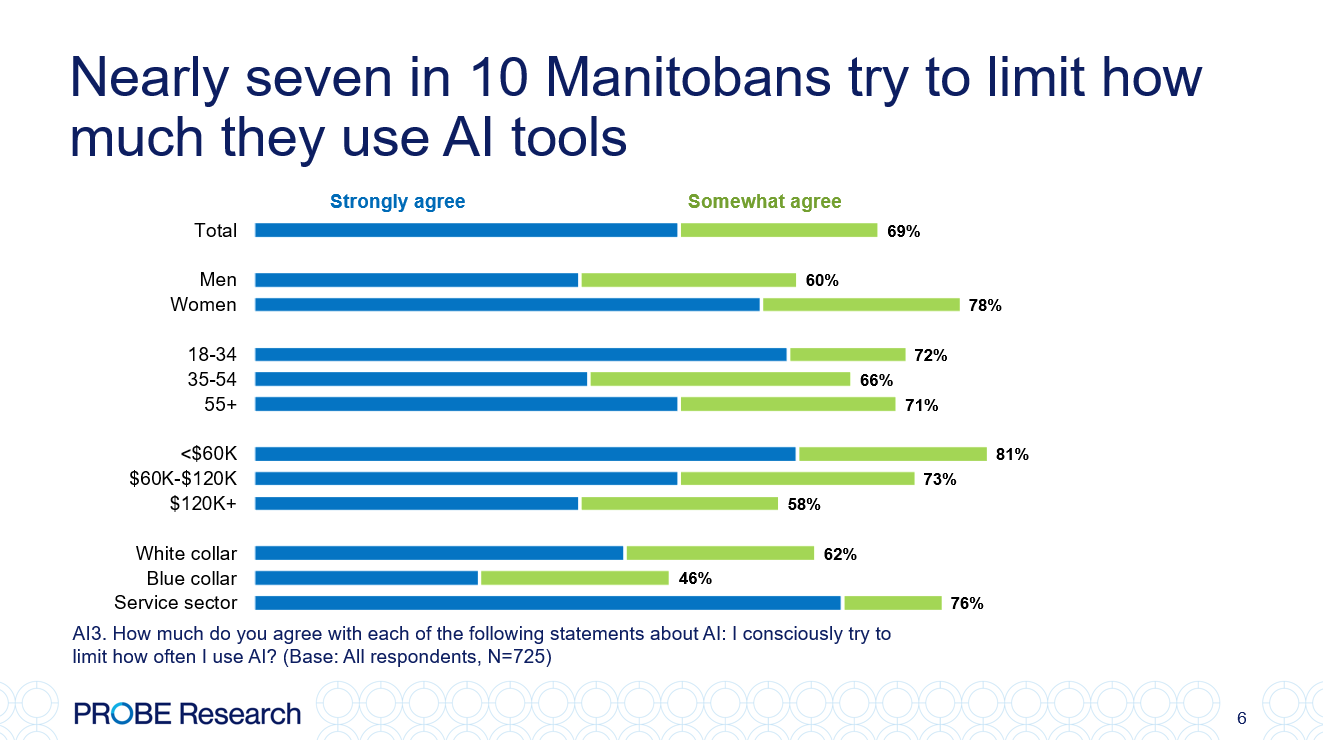
While many Manitobans are embracing AI, some are trying to limit how much they use it. Seven in 10 agree they have set conscious limits on how often they use this tool, with women and lower-income Manitobans most likely to cap their AI usage. White collar and service sector workers are also much more likely to try to scale back how often they use AI.
The Manitoba government recently announced it will conduct public consultations on AI and data privacy, citing the risks this technology may pose if left unregulated. Manitobans are likely to welcome more regulation on this industry. Nearly all (95%) agree online content that uses AI needs to be clearly labelled, and only three in 10 agree there are enough safeguards in place to ensure people and companies are using this technology responsibly.
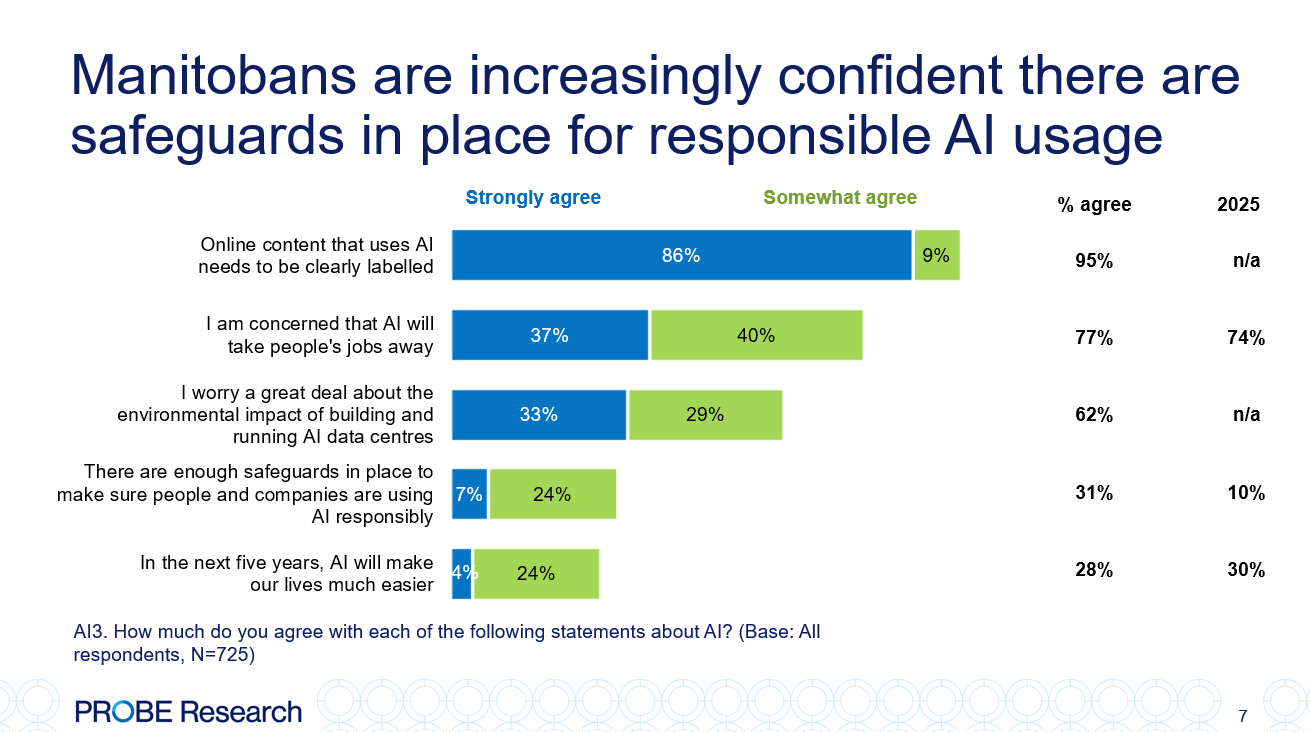
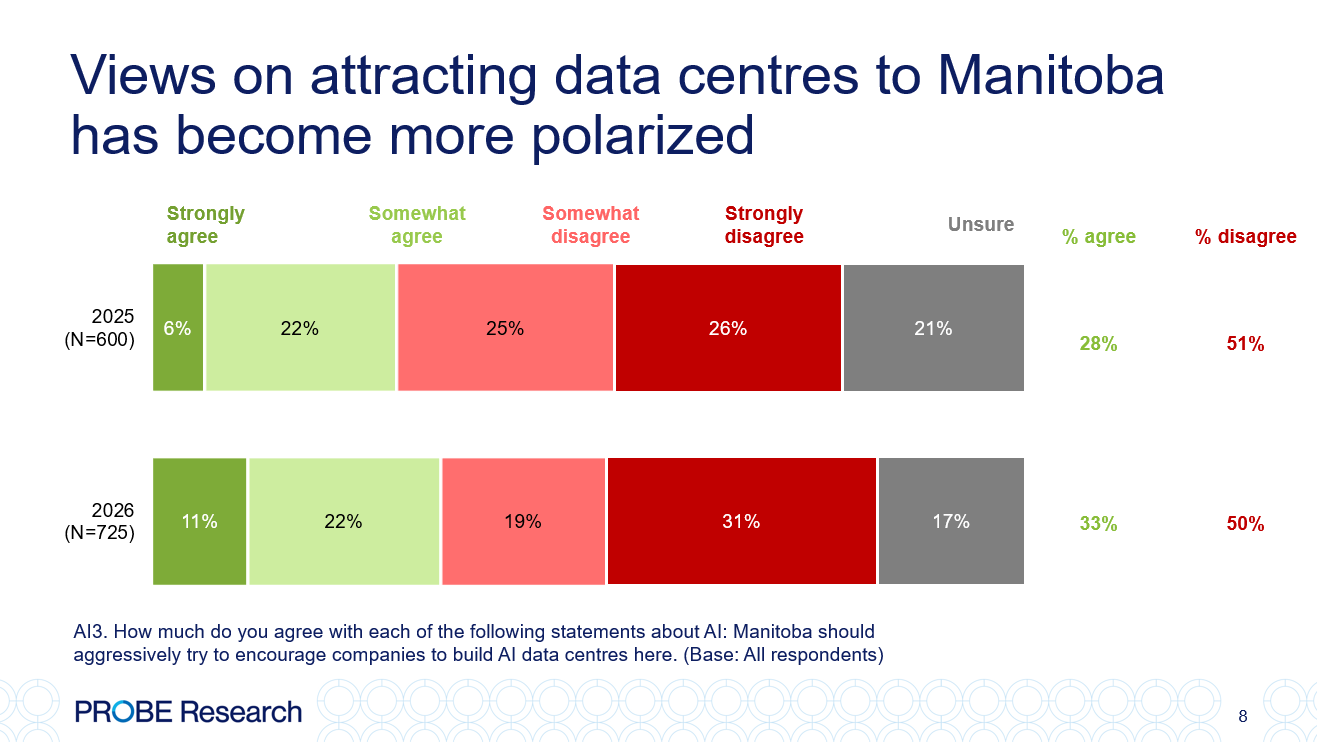
There is also a high level of concern about the environmental impact of the data centres that power AI. More than six in 10 worry a great deal about the electricity and water required to run these. While one-third now agree the provincial government should aggressively try to encourage companies to build data centres here, fully one-half are against this – including more than three in 10 who strongly disagree with pursuing these facilities.
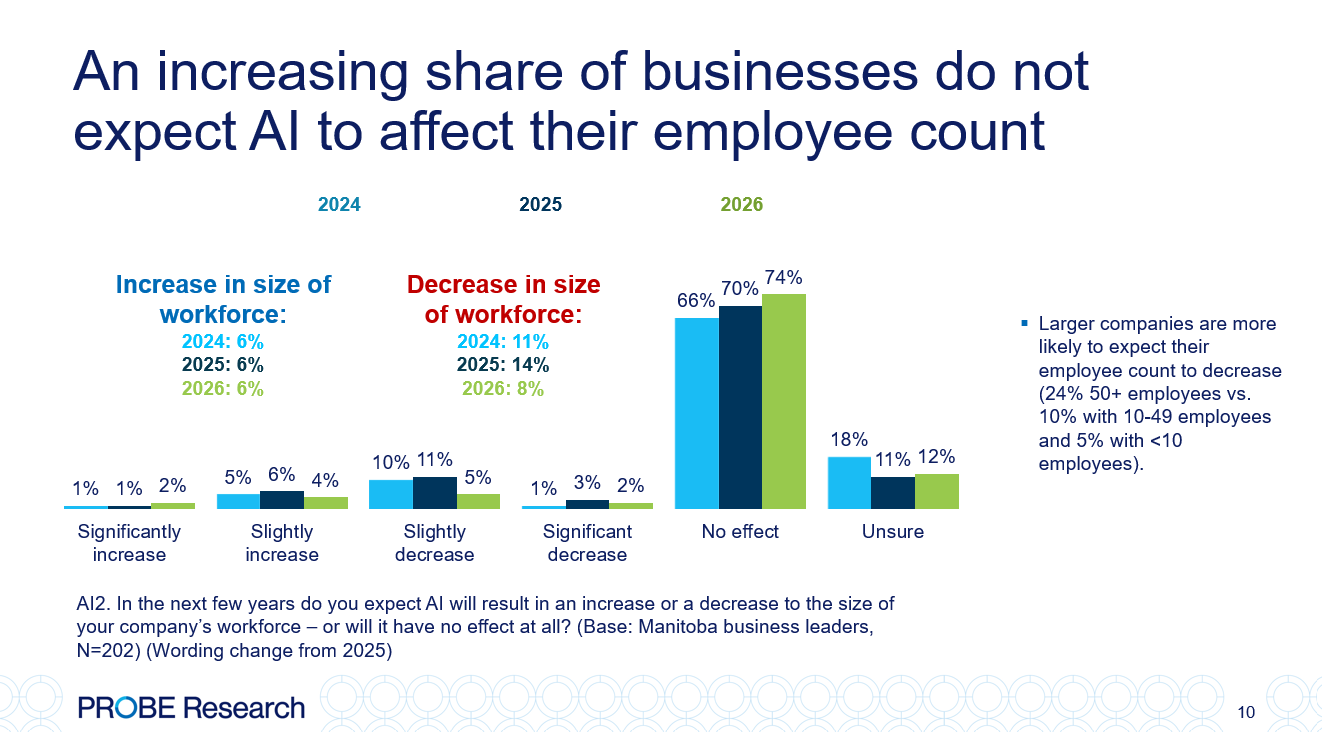
One of the main fears about AI is job loss, but there may be a bit of a mismatch between public concern and corporate reality. More than three-quarters of Manitobans now express worry about AI taking jobs away. However, a decreasing proportion of Manitoba businesses (8%, down from 14% last year) expect to reduce their employee count because of AI. The vast majority of business leaders – three-quarters – expect AI to have no effect on how many people they employ.
Business adoption of AI in Manitoba also appears to be somewhat stalled. Only about one-third of businesses are proactively integrating AI into their operations, with the remainder either not using it at all, or only using it indirectly – if it’s integrated into some piece of software they use, for example.
While AI is one of the most important technological shifts in recent years, public attitudes towards it remain in flux, forming quickly as citizens and businesses grapple with its implications. From this, it’s clear Manitobans do worry about the potential negative aspects of AI – from deepfakes to job loss to the environmental footprint. Manitobans do not want a full-throated and uncritical embrace of AI – they want safeguards that will ensure this technology helps more than it harms.
Methodology:
These results come from two surveys:
- A survey of a representative sample of N=725 Manitoba adults who belong to Probe Research’s online panel. This survey was conducted Jan. 27 to Feb. 9, 2026. Because an online panel is a non-probability sample, no margin of error can be ascribed. For the purposes of comparison, a probabilistic sample of N=725 Manitoba adults would have a margin of error of ± 3.6 percentage points, 19 times out of 20. Minor statistical weighting by age, gender, region and educational attainment was applied to ensure it reflects the known attributes of Manitoba’s population.
- Probe Research’s annual survey of Manitoba business leaders, which was conducted by telephone and online with a representative sample of N=202 business owners and managers between Feb. 6 and March 2, 2026. With a sample of 202, one can say with 95 per cent certainty that the results are within ± 6.9 percentage points of what they would have been if all private-sector business owners/managers in Manitoba had been surveyed.
Disclosure Statement
Probe Research is a member of the Canadian Research Insights Council (CRIC) and confirms that this research fully complies with all CRIC Standards including the CRIC Public Opinion Research Standards and Disclosure Requirements. Learn more here.