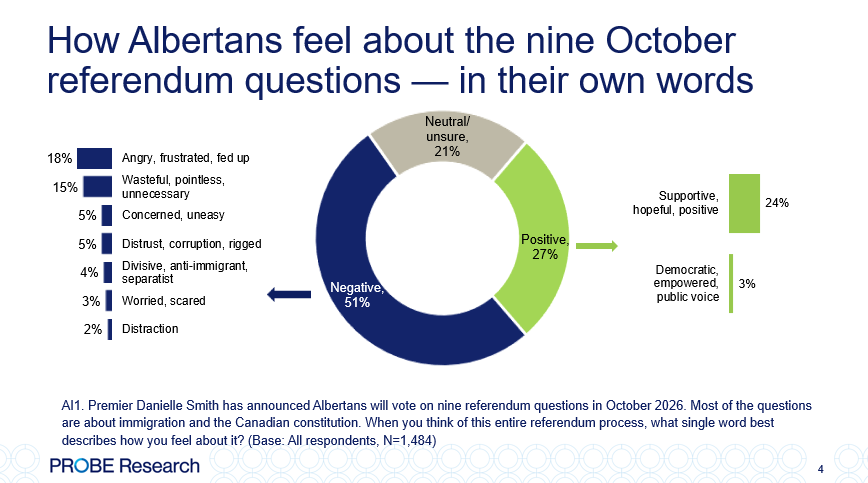
A new Probe Research survey finds Albertans are more likely to feel negatively than positively about the nine referendum questions they will answer in October. When Albertans were asked to use one word to describe the nine referendum questions on the ballot this fall, fully one-half use negative words – like angry, frustrated, or unnecessary – compared to one-quarter who have something positive to say about this.
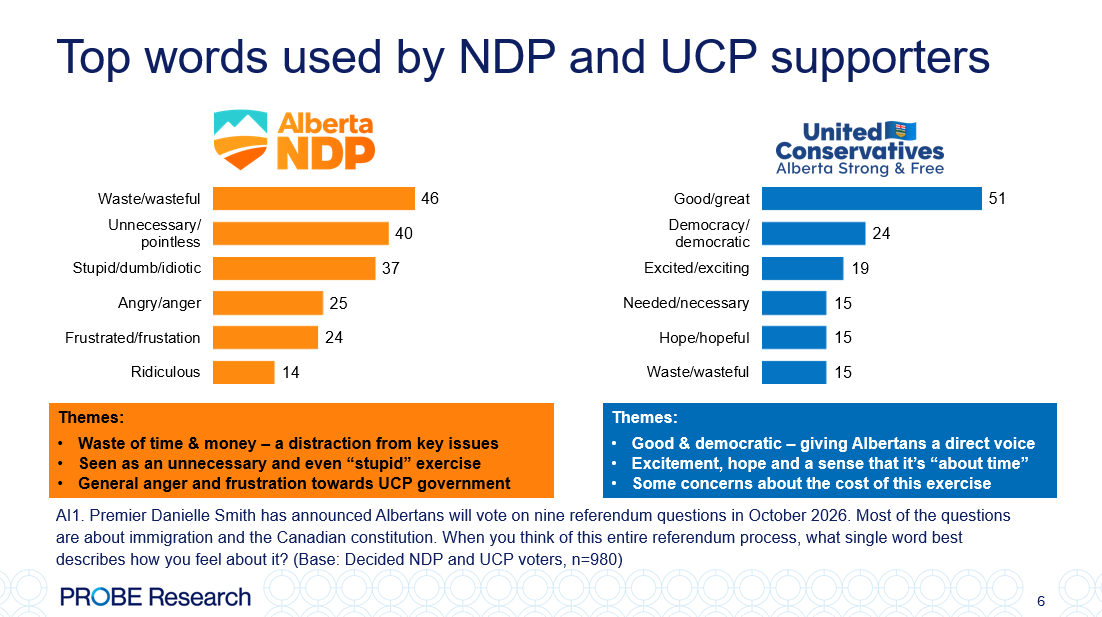
Feelings about the referendums divide sharply along partisan lines. A majority of UCP supporters feel positively about the referendum process, with some saying they are “hopeful” or praising it as “democratic.” Most NDP supporters, meanwhile, express negative feelings.
As for the current direction of the province, Albertans are more likely to say it’s moving in the wrong direction. Opinions are split along partisan and geographic lines, with majorities of UCP supporters and rural residents feeling Alberta is moving in the right direction.
If a referendum question on Alberta separation is asked, seven in 10 Albertans say they would vote No to the province leaving Canada. Only two in 10 would vote Yes, with one in 10 who are unsure. Support for separation is strongest among UCP supporters and rural residents.
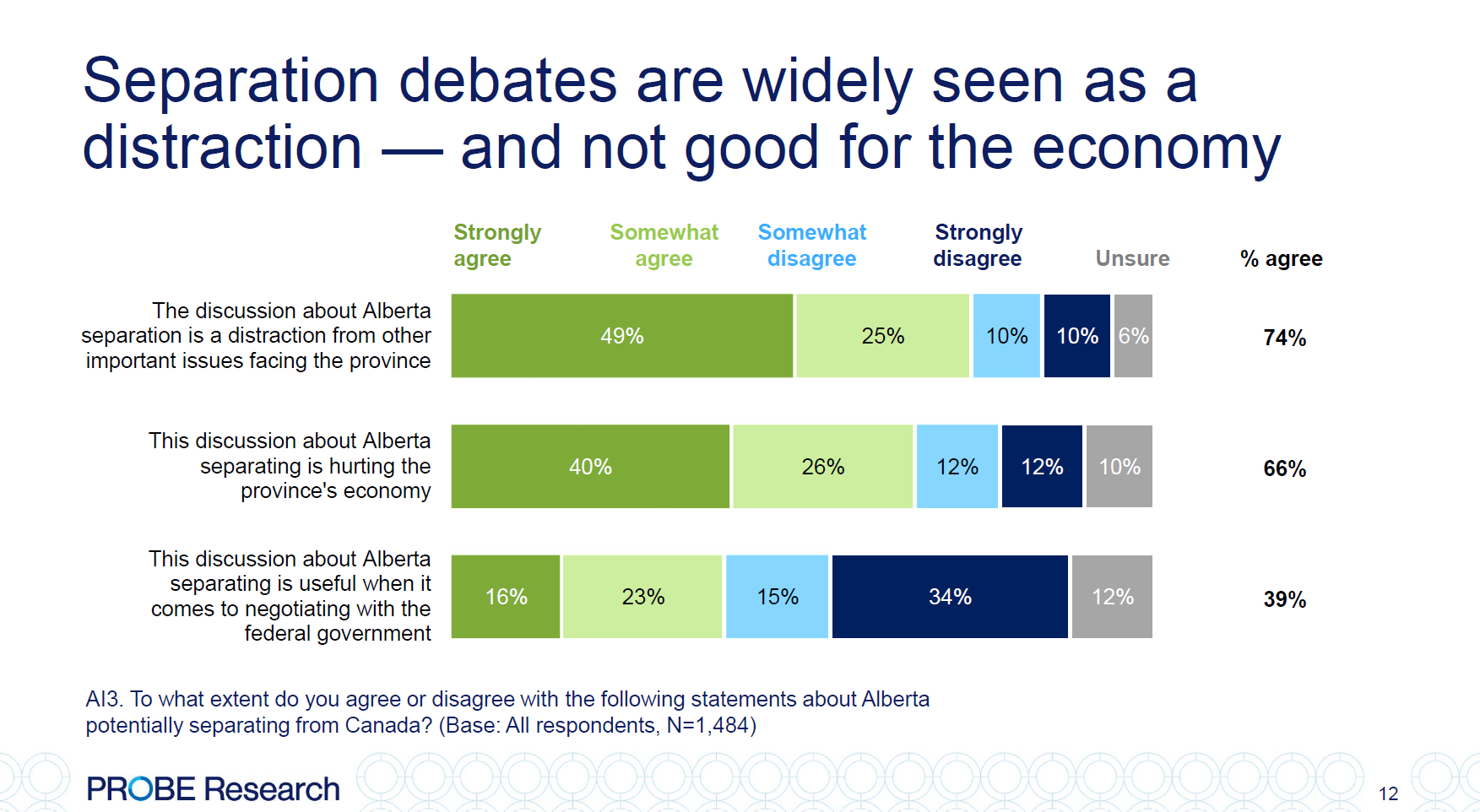
Strong majorities of Albertans agree the separation discussion is harming the province’s economy and distracting from other issues. Roughly two-thirds of Albertans worry about foreign interference in the separation debate. And more than three-quarters of Albertans reject the idea of Alberta joining the United States if it does separate.
Methodology
Probe Research conducted an online survey with a representative sample of 1,484 Alberta adults between April 27 and May 6, 2026. This included an oversample of 598 Calgary adults.
All respondents were recruited from a national online panel (LEO). The sample has been weighted slightly by age, gender, region and educational attainment so it properly reflects Alberta’s population, based on Census data. The totals calculated in this report are based on weighting back oversampled groups to the correct proportions within the overall population.
Because an online survey is a sample of convenience, no margin of error can be ascribed. For the purposes of comparison, a probabilistic sample of 1,484 would have a margin of error of ± 2.5 percentage points, 19 times out of 20. The margin of error would be higher within each of the survey’s population sub-groups.
The survey instrument was designed and paid for by Probe Research.
About Probe Research
Probe Research is one of Canada’s leading public opinion and market research firms, serving as an indispensable insights partner to clients and communities throughout the country.
The Probe team blends the traditions of social science and journalism to help clients better understand the world around them – asking the most insightful questions and using storytelling skills to make data come to life and drive strategic decision-making.
All research conducted by Probe Research is based on responses from real human respondents. Probe Research is a member of the Canadian Research Insights Council (CRIC) and complies with its Public Opinion Research Standards.